

















 English
 Français
 Deutsch
 Português
 Español
 русский
  한국어
한국어 العربية
 Italiano
 Indonesia
 Schweiz
 Polski
 Nederlands
 ישראל - עברית
 Perzisch
 ไทย
ไทย 日本語
日本語 ኢትዮ-አማርኛ
 Việt Nam
 Kiswahili
 Srpski
 Ελληνικά
 繁體中文
繁體中文Understanding Fan Bearing Life in Precision Air Conditioners
09/14/2026Why Bearing Life Deserves Attention
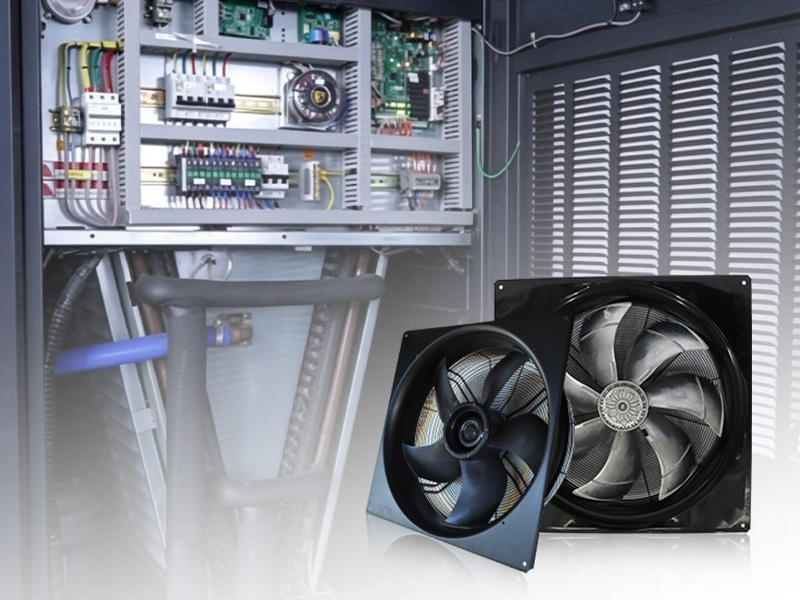
Precision air conditioner fans may run every hour of the year. Bearings support the rotating assembly throughout this duty, and their condition affects noise, vibration, efficiency, and the risk of sudden failure. A fan that looks adequately sized on an airflow curve may still be unsuitable if its bearing system is not matched to continuous service.
Bearing life is statistical rather than an exact expiration date. Manufacturing variation, installation, temperature, contamination, lubrication, and actual load all influence how long an individual bearing will operate.
What L10 Life Means
L10 life is the calculated or tested life that 90 percent of a sufficiently large group of identical bearings are expected to reach or exceed under stated conditions. It does not mean every bearing will fail at that hour, and it should not be interpreted without the associated load, speed, temperature, reliability, and lubrication assumptions.
Two fan suppliers may quote different life values based on different conditions. Procurement teams should request the calculation basis and compare products at the project's actual operating point rather than comparing headline hours alone.
Speed and Mechanical Load
Higher rotational speed increases the number of stress cycles and can raise heat, vibration, and lubricant demand. Variable-speed operation may extend life when the fan spends substantial time below maximum speed, but frequent operation through a resonant range can create additional stress.
Radial and axial loads depend on impeller mass, balance, aerodynamic forces, belt tension where used, and mounting orientation. Excessive belt tension is a common source of unnecessary bearing load in traditional blower assemblies.
Temperature and Lubrication
Lubricant life generally falls as bearing temperature rises. Motor heat, high entering-air temperature, blocked motor cooling, excessive load, and proximity to hot components can all raise the bearing environment. A temperature rating is useful only when the actual local condition is understood.
Sealed bearings simplify maintenance but depend on the original lubricant charge and sealing integrity. Relubricated bearings require the correct lubricant, quantity, interval, and procedure. Overgreasing can be as harmful as insufficient lubrication.
Mounting, Balance, and Contamination
A rigid, correctly aligned mounting protects the bearing from distortion. Fans designed for one shaft orientation may require different bearing arrangements or life calculations when mounted another way. Impeller imbalance from manufacturing error, damage, or dirt deposits creates cyclic bearing loads.
Dust, moisture, salt, and cleaning chemicals can enter damaged seals or corrode bearing surfaces. Keeping filters, cabinet seals, drains, and fan surfaces in good condition reduces both contamination and imbalance.
Specifying and Monitoring Bearing Reliability
A strong specification states the duty point, speed profile, ambient temperature, mounting orientation, expected hours, and required reliability. It also asks whether the quoted life applies to the complete motor bearing system and whether electronics or other components have a shorter expected life.
During operation, trend vibration, sound, temperature, speed, and power. A gradual change is often more informative than a single measurement. Bearing life cannot be guaranteed by one catalog value, but appropriate selection and condition monitoring can substantially reduce unexpected fan outages.
Conclusion
Bearing reliability improves when life data is compared on a common basis and the real effects of speed, load, temperature, orientation, lubrication, balance, and contamination are controlled.