















 English
 Français
 Deutsch
 Português
 Español
 русский
  한국어
한국어 العربية
 Italiano
 Indonesia
 Schweiz
 Polski
 Nederlands
 ישראל - עברית
 Perzisch
 ไทย
ไทย 日本語
日本語 ኢትዮ-አማርኛ
 Việt Nam
 Kiswahili
 Srpski
 Ελληνικά
 繁體中文
繁體中文EC Fan vs AC Fan in Commercial Refrigeration
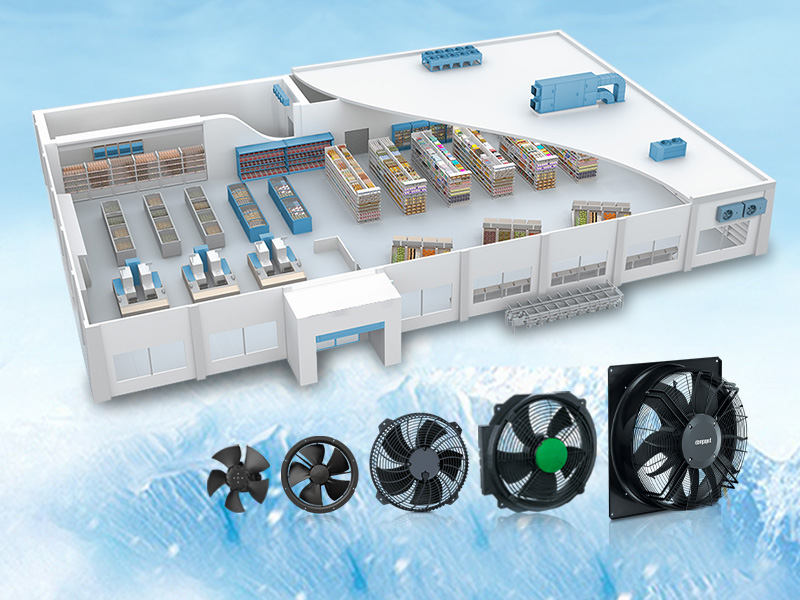
03/03/2026Commercial refrigeration systems are the silent, indispensable workhorses of modern commerce, operating ceaselessly in supermarkets, convenience stores, restaurants, cold storage facilities, and food distribution centers. Their primary mission—maintaining precise, low-temperature environments to preserve perishable goods—comes with a significant and constant energy demand. Within these systems, fans play a critical and often overlooked role, circulating air over evaporator and condenser coils to facilitate heat exchange. Given that these fans typically operate 24 hours a day, 365 days a year, even a marginal improvement in their efficiency translates into substantial reductions in long-term electricity consumption and operational expenses. The choice between traditional Alternating Current (AC) fans and modern Electronically Commutated (EC) fans is therefore not merely a technical specification but a crucial financial and environmental decision. This comprehensive analysis delves into the core differences, performance metrics, and economic implications of EC and AC fan technologies, providing system designers, original equipment manufacturers (OEMs), and facility managers with the insights needed to optimize for performance, reliability, and energy savings.
Understanding AC Fans in Commercial Refrigeration
Alternating Current (AC) fans have been the standard in commercial refrigeration for decades, prized for their simplicity, robustness, and relatively low initial cost. These fans utilize AC induction motors, which are mechanically straightforward and have a long history of proven, if not optimal, performance in various industrial applications.
The fundamental characteristic of a traditional AC fan in this context is its fixed-speed operation. When powered, the motor runs at a constant speed determined by the frequency of the electrical supply (e.g., 50 Hz or 60 Hz) and the motor's design. This "always-on, always-full-speed" approach has significant drawbacks. A refrigeration system's cooling load is not constant; it fluctuates based on factors like ambient store temperature, door openings, product load, and defrost cycles. A fixed-speed fan continues to consume near-full power even when the required heat transfer is minimal, leading to considerable energy waste. Furthermore, the simple on/off cycling of compressors, coupled with constant fan speed, can cause wider temperature swings and less stable storage conditions. While speed control for AC motors is possible using external Variable Frequency Drives (VFDs), this adds cost, complexity, and potential points of failure to the system. Consequently, while AC fans remain in use, particularly in cost-sensitive projects or as direct replacements in legacy equipment, their dominance is waning in an era prioritizing energy efficiency and smart control.
Understanding EC Fans in Commercial Refrigeration
Electronically Commutated (EC) fans represent a significant technological evolution, merging the best aspects of AC and DC motor designs to deliver superior performance. At their core, EC fans are brushless DC motors powered by a standard AC mains supply. The key differentiator is the integrated power electronics module, which converts the incoming AC power to DC and then precisely controls the commutation of the DC current in the motor windings. This built-in electronic commutation is what gives the technology its name and its advantages.
The integration of motor and drive is a game-changer. It allows an EC fan to function as a complete, smart airflow unit capable of variable speed operation without any need for external motor controllers or VFDs. The motor itself is inherently more efficient due to its permanent magnet design and the precise electronic control of the magnetic field, which minimizes electrical losses. This fundamental design shift enables EC fans to adapt their speed—and thus their energy consumption—in real-time to match the exact cooling demand of the refrigeration system, a capability that lies at the heart of their energy-saving potential.
Energy Efficiency and Operational Cost Comparison
The debate between EC and AC fans is decisively settled in the realm of energy efficiency, which directly dictates operational costs. The performance gap is most evident under the partial-load conditions that characterize the vast majority of a refrigeration system's operating life.
EC Fan Efficiency: The efficiency of an EC motor remains exceptionally high across a broad speed range. When the system's cooling demand drops, the fan can slow down proportionally. The power consumption of an EC fan is not linear; it follows a cube law relationship with speed. Reducing fan speed by 20% can lower its power draw by nearly 50%. This, combined with lower inherent electrical and mechanical losses in the motor, results in dramatic energy savings. In real-world commercial refrigeration applications, replacing fixed-speed AC fans with variable-speed EC fans consistently yields energy reductions of 30% to 50% for the fan motors themselves. These savings contribute directly to lower electricity bills and a reduced carbon footprint.
AC Fan Efficiency: In contrast, a standard AC induction motor is most efficient at or near its full-load, designed speed. Its efficiency plummets when operated at reduced speeds via an external VFD, and without a VFD, it has no ability to modulate at all. A fixed-speed AC fan simply continues to draw near-constant power regardless of actual need. The energy wasted over thousands of operating hours is immense. While the upfront cost of an AC fan and a simple contactor is lower, the total cost of ownership is overwhelmingly skewed by the ongoing energy expenditure, where AC technology is at a severe disadvantage.
Speed Control, System Stability, and Product Integrity
Beyond raw energy savings, the intelligent speed control of EC fans confers major advantages for the overall refrigeration system's performance and the quality of the products it preserves.
Precise Airflow Modulation: EC fans can be seamlessly integrated with the system's controller to adjust their speed based on signals like evaporator coil temperature, suction pressure, or cabinet air temperature. As the coil temperature drops after a defrost cycle or during periods of low load, the EC fan can ramp down. This maintains optimal air velocity over the coil for efficient heat transfer without overcooling the product or creating excessive dehydration. It also helps maintain a more stable and uniform temperature throughout the display case or cold room.
Reduced Compressor Cycling: By providing just the right amount of airflow, EC fans help the system meet the cooling load more smoothly. This can reduce the on/off cycling frequency of the compressor, which is a major source of inefficiency and wear. A more balanced system operation extends the lifespan of the compressor, the most expensive component in the circuit.
Improved Frost Management: In low-temperature applications, precise airflow control can minimize the introduction of warm, moist air into the case. This reduces frost buildup on the evaporator coils, extending the time between defrost cycles. Fewer defrosts mean less energy used for heating and more time spent in productive cooling mode, enhancing both efficiency and temperature stability.
Total Cost of Ownership (TCO) and Reliability
A prudent investment analysis looks beyond the initial purchase price. The Total Cost of Ownership (TCO) encompasses acquisition, installation, energy consumption, maintenance, and downtime over the asset's operational life.
EC Fan TCO: While the unit cost of an EC fan is higher than a basic AC fan, it delivers a lower TCO in almost all commercial applications. The significant and continuous energy savings typically result in a payback period of one to three years. Thereafter, the savings contribute directly to profitability. Furthermore, EC fans have fewer wearing parts (no brushes, simpler mechanics) and generate less heat during operation. This leads to higher reliability, longer service life, reduced maintenance costs, and lower heat rejection into the conditioned space, which indirectly saves on store air conditioning costs.
AC Fan TCO: The lower initial price of an AC fan is quickly eroded by its higher lifetime energy costs. The constant high-speed operation leads to greater wear on bearings and other components. The additional heat generated by a less efficient motor must also be removed by the store's HVAC system, adding a hidden operational cost. In systems where external VFDs are added for control, the TCO increases further due to the cost of the drive, additional installation complexity, and the potential for an extra component to fail.
Noise, Environment, and Regulatory Compliance
Noise Performance: The acoustic profile of equipment is increasingly important in retail environments. The variable-speed operation of an EC fan allows it to run slower and quieter during off-peak hours, enhancing customer comfort. The soft-start and smooth speed transitions also eliminate the audible "clunk" of contactors engaging AC fan motors. In contrast, fixed-speed AC fans produce a constant, often intrusive, level of noise.
Environmental and Regulatory Drivers: Global and regional regulations are relentlessly pushing for higher energy efficiency in commercial equipment. Standards like the European Ecodesign Directive, various ENERGY STAR certifications, and building codes worldwide are setting stricter limits on energy consumption. EC fan technology is a key enabler for OEMs to meet and exceed these evolving requirements. Specifying high-efficiency EC fans helps new refrigeration systems achieve better energy ratings, comply with regulations, and appeal to environmentally conscious businesses and consumers.
Conclusion
The comparison between EC fans and AC fans in commercial refrigeration reveals a clear trajectory toward smarter, more adaptive technology. While AC fans had their place in an era of cheap energy and simpler designs, the demands of modern commerce—for lower operating costs, superior product preservation, regulatory compliance, and sustainability—strongly favor EC technology. EC fans deliver decisive advantages in energy efficiency, precise environmental control, system reliability, and lifetime cost savings. For any new installation, retrofit project, or equipment upgrade where energy performance matters, EC fans are no longer just an alternative; they represent the definitive, forward-thinking choice for a sustainable and profitable commercial refrigeration operation. The investment in EC technology is an investment in long-term efficiency, stability, and bottom-line results.