

















 English
 Français
 Deutsch
 Português
 Español
 русский
  한국어
한국어 العربية
 Italiano
 Indonesia
 Schweiz
 Polski
 Nederlands
 ישראל - עברית
 Perzisch
 ไทย
ไทย 日本語
日本語 ኢትዮ-አማርኛ
 Việt Nam
 Kiswahili
 Srpski
 Ελληνικά
 繁體中文
繁體中文EC Fans vs AC Fans for AHUs: What Is the Difference?
08/17/2026Two Ways to Produce Controlled Airflow
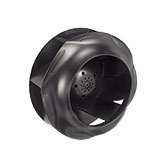
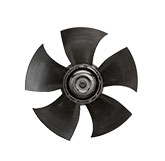
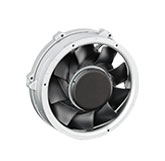
The terms EC fan and AC fan describe different motor and control architectures rather than two completely separate aerodynamic families. Either may drive a centrifugal or axial impeller, although AHUs commonly use centrifugal wheels. A traditional AC fan typically uses an induction motor supplied from the alternating-current mains, with speed fixed by the electrical frequency or varied by an external variable-frequency drive. An electronically commutated fan uses a permanent-magnet motor and onboard electronics to control commutation and speed. The practical comparison therefore involves the complete package: motor, drive electronics, impeller, controls, installation, service strategy, and performance across the AHU operating range.
Motor Operation and Speed Control
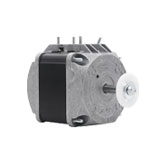
An AC induction motor creates a rotating magnetic field from the supplied frequency, and its rotor runs with slip relative to that field. Where variable speed is required, a VFD changes the frequency and voltage delivered to the motor. An EC motor rectifies the incoming supply and electronically switches current through its windings according to rotor position and the commanded speed. Control electronics are normally integrated with the motor. Both systems can regulate airflow effectively. EC integration reduces the need to select and mount a separate drive, while an AC motor with VFD allows the drive and motor to be specified, located, and serviced as distinct components.
Efficiency Across the Load Profile
EC solutions are often attractive at part load because permanent-magnet motors and integrated control can maintain good efficiency over a broad speed range. An AC motor and a well-matched VFD can also perform efficiently, particularly at larger duties and near favorable operating points. The meaningful comparison is not a single motor-efficiency label. It should include drive losses, motor loading, fan aerodynamic efficiency, pressure setpoints, and hours spent at each operating condition. A highly efficient motor attached to an oversized or poorly selected impeller can consume more energy than a sensibly selected alternative. Project analysis should use the expected duty profile and package data rather than broad technology claims.
Integration and Installation
An EC fan commonly arrives as a tested motor-impeller-electronics assembly. Power and control wiring can be straightforward, and multiple units can form a compact array. The installer must still follow requirements for fusing, isolation, grounding, communication cabling, leakage current, and electromagnetic compatibility. An AC arrangement requires a motor starter for fixed speed or a VFD for modulation, plus coordination among the fan, motor, drive, enclosure, and cables. That adds components but offers design flexibility, including locating the drive away from heat or moisture. Space, heat rejection, bypass requirements, harmonic mitigation, and the facility’s electrical standards can influence which architecture is easier to integrate.
Controls and Building Automation
EC fans often accept analog commands and may offer digital communication with operating data and alarms. This can make them convenient for fan arrays and packaged AHUs. The available points and protocol behavior vary, so the controls team must verify what is actually supported. VFD-driven AC fans are familiar to many building-automation contractors and can provide robust speed, current, status, and fault information. They also support established sequences for safeties and fire modes. In either case, good sensing and logic matter more than the label. Static-pressure reset, airflow measurement, minimum ventilation limits, failure response, and stable loop tuning determine how effectively the fan follows real demand.
Maintenance and Replacement
AC motors and separate VFDs are widely understood and may be replaceable through local supply channels. Bearings, belts where present, cooling fans, and drive capacitors have their own maintenance considerations. An EC fan removes belts in most AHU applications and reduces separate components, but a fault in integrated electronics may require replacement of a proprietary motor or complete fan module. Availability, configuration tools, and product-generation changes should be considered for critical facilities. Neither technology is maintenance free. Impeller cleanliness, electrical connections, cooling conditions, vibration, condensation, and fault records all need attention. A lifecycle plan should include access, spares, settings, and acceptable downtime.
Fan Arrays and Large Duties
EC fans are strongly associated with fan-wall retrofits because smaller integrated modules are easy to arrange in parallel and control together. They can provide partial redundancy and fit through access routes that would not accommodate one large fan. AC fans can also be used in arrays, either with individual drives or a coordinated drive strategy, and a single large AC-driven fan may be practical for high-capacity applications. The array decision should consider efficiency, acoustic interaction, backflow through an idle fan, electrical distribution, controls complexity, and maintenance labor. More fans create more individual components even when each component is compact and accessible.
Noise and Electromagnetic Considerations
Sound performance depends primarily on the impeller, speed, pressure duty, inlet flow, and casing, but motor-control architecture can affect tonal character. EC electronics and VFDs both use switching, which can produce audible or electromagnetic effects if equipment, cables, grounding, or carrier settings are poorly coordinated. A VFD may be located remotely or enclosed separately, while EC electronics remain at the fan. Sensitive applications should evaluate octave-band and tonal data for the complete assembly and verify compliance with relevant electrical requirements. No technology should be described as inherently quiet without reference to its selected operating point and installation environment.
Cost and Lifecycle Value
Initial cost comparisons must include all required components. An EC package may include functions that appear as separate line items in an AC motor and VFD solution. Conversely, replacement of a standardized motor or drive may be less dependent on a specific fan product. Energy cost, operating hours, load variation, commissioning time, spare strategy, service capability, and expected equipment life all affect value. For a small variable system, integrated EC control may be compelling. For a facility standardized around serviceable VFDs and large motors, an AC solution may align better with operational practice. The lowest purchase price is not necessarily the lowest lifecycle cost.
Choosing Between EC and AC
Start with airflow, pressure, operating range, air temperature, redundancy, sound, and control requirements. Then compare complete certified or manufacturer-documented fan packages at the relevant points. Check electrical supply, communication interfaces, motor cooling, service access, environmental protection, and local support. EC fans tend to excel in compact, variable-speed, modular applications, while AC motors with VFDs remain versatile and familiar across a wide capacity range. There is no universal winner for every AHU. The best choice is the one that meets the system curve efficiently, integrates cleanly, and can be commissioned and maintained by the people responsible for the building.