










 English
 Français
 Deutsch
 Português
 Español
 русский
  한국어
한국어 العربية
 Italiano
 Indonesia
 Schweiz
 Polski
 Nederlands
 ישראל - עברית
 Perzisch
 ไทย
ไทย 日本語
日本語 ኢትዮ-አማርኛ
 Việt Nam
 Kiswahili
 Srpski
 Ελληνικά
 繁體中文
繁體中文In-Row Cooling Fans: Bringing Airflow Closer to High-Density IT Loads
09/01/2026Why closer cooling changes airflow design
In-row cooling places the cooling unit close to the heat source. That simple change can reduce the distance hot air travels before it reaches a coil, and it can make cooling more responsive to row-level load. Fans are central to this design because they pull or push air through a compact unit where coil face area, grille geometry, filters, and service access all compete for space.
Unlike a perimeter system, an in-row unit does not simply condition the room as a large volume. It participates in a local airflow pattern. In a contained hot aisle, it may draw hot exhaust air directly from the aisle. In a cold aisle design, it may deliver conditioned air near server inlets. The fan must therefore be selected for the unit and for the surrounding containment strategy.
Pressure and compactness
In-row systems can be pressure-demanding because they must deliver useful airflow through a relatively compact footprint. The air path may include a dense coil, grilles, filters, cabinet transitions, and short discharge paths. A fan that looks adequate by free-air rating may fall short once installed resistance is included. This is why static pressure and installed performance matter more than headline airflow.
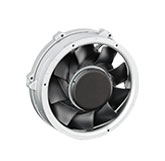
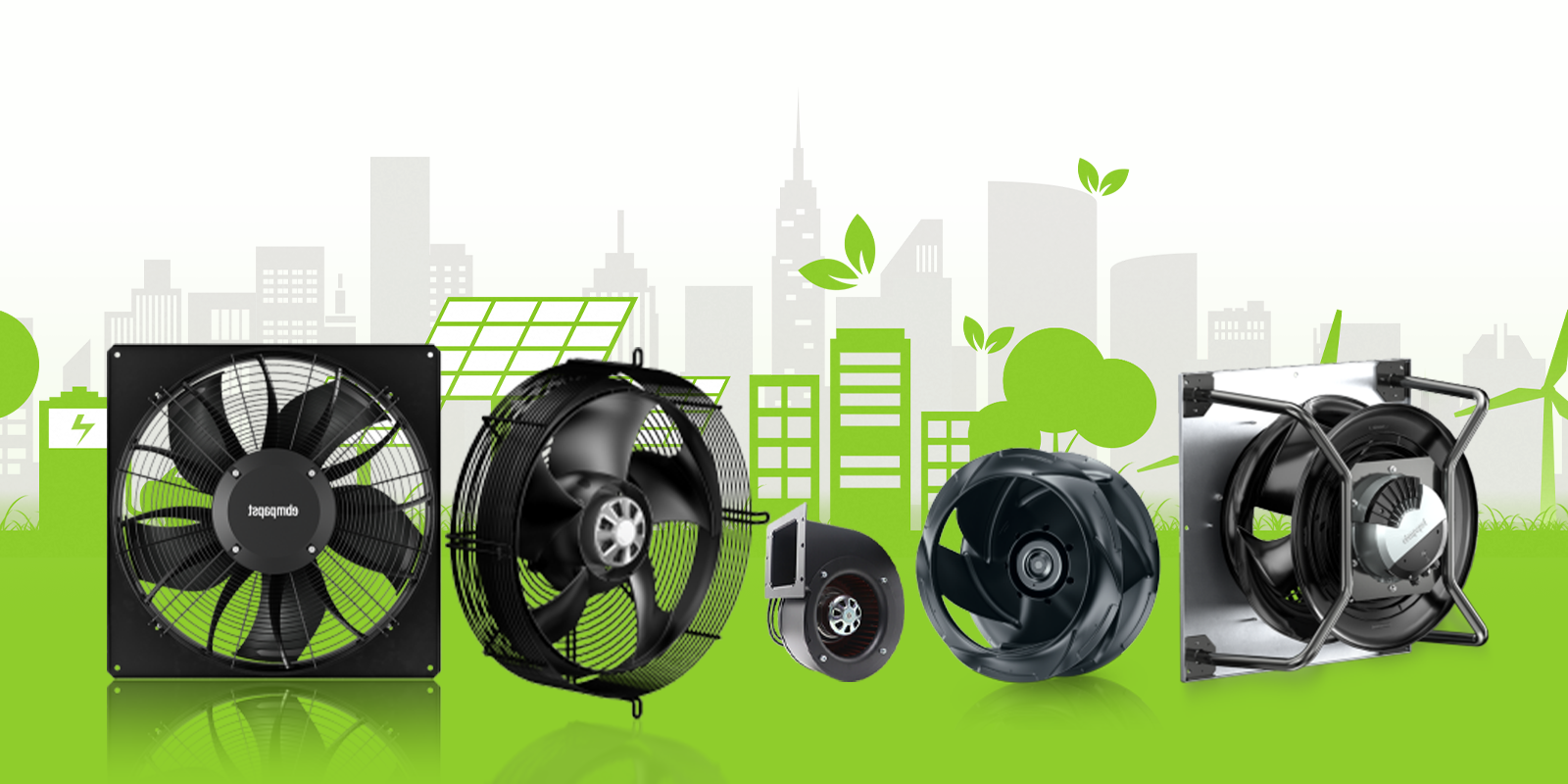
ebm-papst materials describe AxiEco 200 as a compact fan for pressure-demanding applications and list in-row cooling among its data centre use contexts. That does not eliminate design work, but it identifies the kind of product attributes that in-row equipment often needs: compact size, pressure capability, controllability, and reliability under continuous operation.
Control near the heat source
The closer a fan sits to the IT load, the more important control stability becomes. If the fan responds too aggressively to a local temperature spike, it may create airflow swings that neighboring racks experience as instability. If it responds too slowly, hot exhaust can accumulate. In-row fan control should therefore use sensor placement and logic that represent the row rather than a single noisy measurement point.
Good control also protects against overcooling. In-row units are sometimes added to solve a hot spot, then left running at high output after the hot spot has been corrected by containment or IT relocation. That wastes fan energy and may create unwanted airflow loops. Variable-speed fans can help, but only if the control sequence is tuned to the real operating pattern.
Working with containment
In-row fans and containment should be designed together. A contained hot aisle gives the in-row unit a more predictable return air source. A contained cold aisle can reduce mixing at server inlets. In both cases, leakage paths change the fan's real workload. Gaps under racks, missing blanking panels, cable openings, and doors left open can all cause the fan to move air that does not contribute to IT cooling.
The commissioning process should include door-open scenarios, partial rack loads, failed fan alarms, and maintenance access. If a technician removes a panel or opens a row door, the local pressure balance may change. A resilient in-row fan application should tolerate normal operational behavior without producing immediate thermal instability.
Where in-row fans fit in a broader cooling roadmap
In-row cooling is often a bridge technology. It can support higher rack densities in an existing room without replacing every perimeter unit. It can also coexist with rear door heat exchangers, direct-to-chip liquid cooling, and traditional air cooling. The fan design must therefore be flexible enough to serve mixed environments rather than a single perfect design day.
The right in-row fan is not selected from airflow alone. It is chosen by understanding the local heat load, coil performance, rack arrangement, containment leakage, service strategy, controls, and future density plan. When those elements are aligned, in-row fans help make cooling local, adjustable, and more efficient without forcing the entire data hall into one cooling architecture.
Application perspective
In-row cooling fan content should not imply that adding local cooling automatically solves density. The row still needs enough power capacity, cable management, water or refrigerant distribution, condensate strategy where applicable, controls integration, and emergency behavior. The fan is one part of that local thermal machine. Its success depends on the surrounding unit design.
A strong design review asks whether the in-row unit is supporting a temporary hot spot, a permanent high-density row, or a phased migration toward liquid cooling. Those scenarios justify different fan redundancy and control choices. Temporary support may prioritize fast deployment. Permanent high-density cooling may prioritize monitoring and serviceability. A migration plan may prioritize flexibility as racks change over time.
The location of the unit inside the row also matters. If the in-row cooler is too far from the dominant heat source, or if containment openings allow air to bypass the intended path, fan output may not translate into better rack inlet conditions. Designers should review row geometry, cabinet loading, perforation patterns, and service aisles. The fan should be selected for the physical row that actually exists, not for a simplified diagram.
Maintenance clearance is another underrated issue. In-row coolers are installed in valuable white-space real estate, often surrounded by racks that cannot be moved easily. Fan modules, filters, and controls should be reachable without creating unsafe working conditions or long exposure of the cooling path. Service access is part of the application, not a separate afterthought.
That is why field observation should remain part of the final acceptance process.
FAQ
Q: What is in-row cooling?
A: In-row cooling places cooling units close to server racks, usually within the row, so heat can be captured and conditioned nearer to the source.
Q: Why do fans matter in in-row units?
A: Fans move hot return air through the coil and deliver conditioned air back to the row or containment space. Their pressure capability and control behavior directly affect performance.
Q: Is in-row cooling only for very high density racks?
A: No. It is often used for high-density zones, but it can also support retrofit spaces, mixed-density environments, and containment strategies.
Q: Where does ebm-papst mention in-row cooling?
A: ebm-papst lists in-row cooling among data center applications for centrifugal fans and describes AxiEco 200 as suitable for in-row cooling in its data centre materials.
Q: What should be avoided in in-row fan design?
A: Avoid uncontrolled bypass, poor sensor placement, fixed full-speed operation, blocked service access, and fan selections that ignore coil and grille pressure drop.