


















 English
 Français
 Deutsch
 Português
 Español
 русский
  한국어
한국어 العربية
 Italiano
 Indonesia
 Schweiz
 Polski
 Nederlands
 ישראל - עברית
 Perzisch
 ไทย
ไทย 日本語
日本語 ኢትዮ-አማርኛ
 Việt Nam
 Kiswahili
 Srpski
 Ελληνικά
 繁體中文
繁體中文Custom Fan Solutions for Precision Air Conditioner OEMs
09/16/2026When a Standard Fan Is Not Enough
Standard catalog fans cover many precision cooling applications, but an OEM may face a cabinet depth, airflow range, voltage, interface, sound target, or environmental condition that available products do not satisfy. Customization can range from a connector or software setting to a new impeller, motor, frame, or control package.
A successful program starts by defining why customization is needed. Changing a product without a measurable requirement increases cost and validation work without guaranteeing a better air conditioner.
Define the Real Operating Envelope
The specification should include airflow and pressure at minimum, nominal, and maximum conditions; clean and loaded filters; relevant air density; supply voltage tolerance; expected speed profile; and maximum input power. Noise, vibration, lifetime, temperature, humidity, ingress protection, and corrosion requirements should be stated as measurable targets.
Cabinet geometry must be shared early. Inlet clearance, discharge obstructions, adjacent fans, coil position, guards, service panels, and mounting orientation can change installed performance.
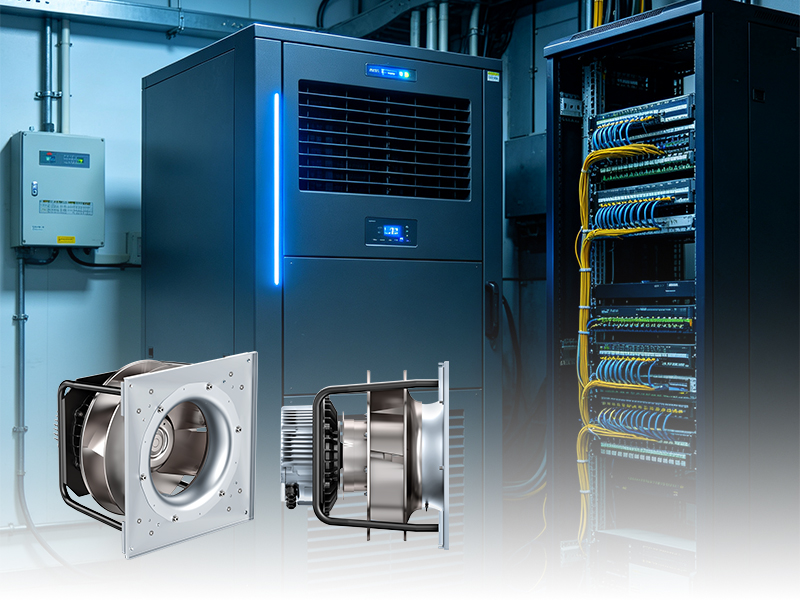
Mechanical Customization
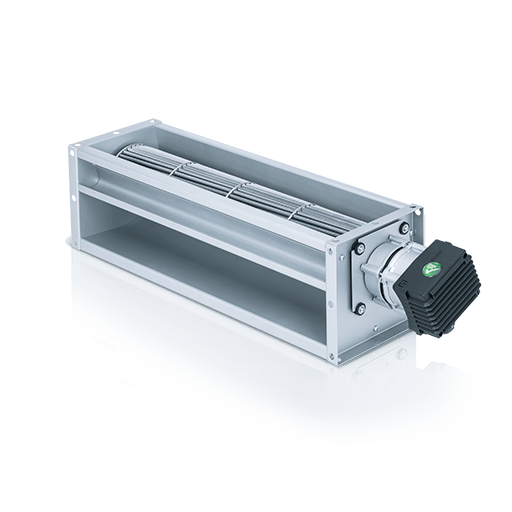
Mechanical work may include impeller diameter or blade geometry, mounting holes, frame shape, motor position, guard design, cable exit, or airflow direction. Each change should consider balance, structural stress, transport vibration, assembly tolerance, and technician access.
Prototype parts should be tested in the actual or representative cabinet. Free-air testing alone cannot reveal all system effects, recirculation, or panel vibration.
Electrical and Software Integration
Electrical options can include voltage, current limits, connector type, cable length, alarm output, tachometer signal, analog scaling, PWM behavior, and digital communication. The fan's response to lost commands, invalid data, overtemperature, blocked rotation, and power recovery should be documented.
OEM-specific firmware requires version control and change notification. A replacement fan supplied years later must remain compatible with the installed controller or provide a managed migration path.
Validation and Approval
The validation plan should cover airflow, pressure, input power, efficiency, sound, vibration, temperature rise, electrical protection, control response, environmental exposure, and endurance. Tests should include the corners of the approved operating envelope, not only the easiest nominal point.
Acceptance criteria, sample quantities, test ownership, and reporting format should be agreed before prototypes arrive. Any difference between prototype and production tooling must trigger an appropriate confirmation test.
Production and Lifecycle Supply
A custom product creates a long-term supply relationship. The OEM should review manufacturing controls, traceability, end-of-line testing, capacity, lead time, spare-part policy, and end-of-life notification. Critical dimensions, firmware, materials, and approved subcomponents need controlled documentation.
Customization delivers value when it improves the complete precision air conditioner and remains manufacturable over its service life. Clear requirements and joint validation are more important than the number of customized features.
Conclusion
Custom fan development works best when measurable equipment-level requirements guide every mechanical, electrical, software, validation, and supply-chain decision.