













 English
 Français
 Deutsch
 Português
 Español
 русский
  한국어
한국어 العربية
 Italiano
 Indonesia
 Schweiz
 Polski
 Nederlands
 ישראל - עברית
 Perzisch
 ไทย
ไทย 日本語
日本語 ኢትዮ-አማርኛ
 Việt Nam
 Kiswahili
 Srpski
 Ελληνικά
 繁體中文
繁體中文How to Size Backup Power for Precision Cooling Fans
09/17/2026Why Airflow May Need Emergency Power
During a utility outage, servers, telecommunications equipment, controls, batteries, and laboratory systems may continue operating from UPS or generator power. If precision cooling fans stop, residual heat can accumulate rapidly even when compressors or chilled-water production are temporarily unavailable. Maintaining airflow can reduce hot spots and use any stored cooling capacity more effectively.
The required backup strategy depends on thermal ride-through, equipment shutdown time, generator start time, cooling architecture, and the consequence of temperature excursions. Not every fan must necessarily remain at full speed.
Identify the Critical Fan Load
List every fan required to maintain the approved emergency condition, including unit supply fans, in-row fans, return fans, control-panel cooling fans, and any dampers or actuators needed to preserve the airflow path. Separate essential loads from comfort or noncritical ventilation.
Define the emergency airflow target. It may be lower than normal design airflow if IT load is reduced or compressors are unavailable, but it must be supported by a thermal analysis and operating procedure.
Running Power and Startup Behavior
Use measured or manufacturer-provided electrical input at the emergency operating point. Nameplate maximum power is useful for protection but may overstate normal UPS demand. Conversely, using only average power may underestimate the load when all fans accelerate after a transfer.
Traditional AC motors can draw significant starting current. EC fans often use controlled electronic starting, but multiple units starting together can still create a step load or inrush. The UPS, generator, protective devices, and wiring must tolerate the documented behavior.
UPS and Generator Compatibility
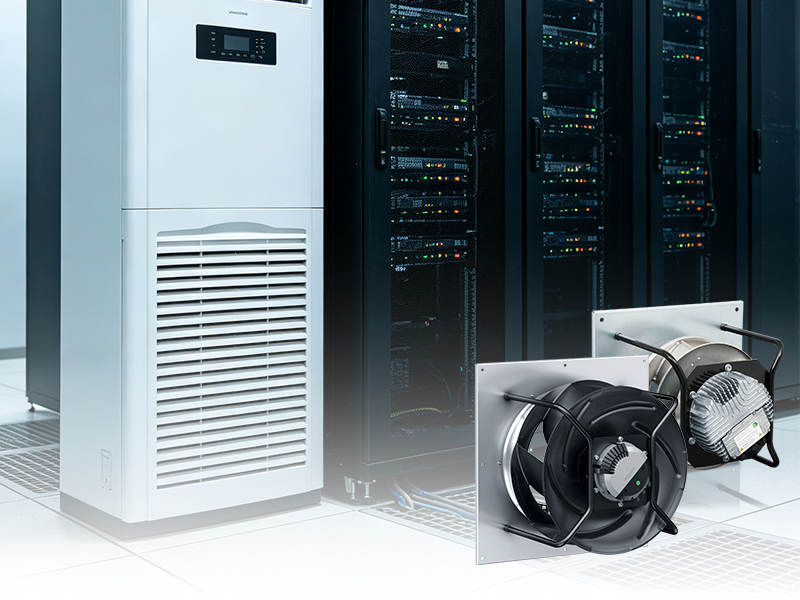
Confirm voltage, frequency, waveform, harmonic current, power factor, leakage current, and protective-device compatibility. Integrated electronics may respond differently to some UPS output modes or generator voltage transients. Supplier confirmation and representative testing are preferable to assumptions based only on rated watts.
Generator sizing should consider the complete emergency cooling system and other facility loads. Fan acceleration may need to be delayed until the generator has stabilized, especially when compressors, pumps, or chillers also restart.
Sequencing and Runtime
Staggered fan starts reduce step loading and can prioritize the zones with the shortest thermal margin. The controller should retain setpoints and safe fallback operation during network interruption. After power returns, fans should not remain stopped because a remote command has not yet recovered.
UPS runtime is calculated from the critical load and the time required for generator start, controlled shutdown, or another cooling source to become available. Battery aging, temperature, inverter efficiency, and future load growth should be included.
Testing the Emergency Mode
Commissioning should simulate power loss, transfer, generator operation, communication interruption, and return to normal supply. Verify fan restart, sequence timing, actual input power, airflow, alarms, and room-temperature response. Test both normal and reduced-load emergency modes if both are specified.
Backup power sizing is complete only when the electrical system and cooling control sequence have been proven together. Documented tests turn an assumed ride-through capability into an operational one.
Conclusion
Emergency fan power must be sized as part of a tested cooling sequence. Load data, startup behavior, runtime, electrical compatibility, and automatic recovery all determine whether airflow survives an outage.