









 English
 Français
 Deutsch
 Português
 Español
 русский
  한국어
한국어 العربية
 Italiano
 Indonesia
 Schweiz
 Polski
 Nederlands
 ישראל - עברית
 Perzisch
 ไทย
ไทย 日本語
日本語 ኢትዮ-አማርኛ
 Việt Nam
 Kiswahili
 Srpski
 Ελληνικά
 繁體中文
繁體中文Common Cooling Tower Fan Problems and Airflow Improvements
10/09/2026Begin with symptoms and measurements
Cooling tower fan problems may appear as warm leaving water, reduced process capacity, high fan current, abnormal noise, vibration, frequent alarms, or longer run time. Record when the symptom occurs and under what heat load and weather condition. A visual inspection and basic measurements are more reliable than replacing parts from assumption.
Reduced airflow
Low airflow may result from reduced speed, damaged or dirty blades, an obstructed inlet, fouled fill, closed louvers, blocked eliminators, excessive blade clearance, air leakage, or recirculation. Compare the measured speed and rotation with the design condition. Inspect the complete airflow path. If the fan sounds normal but water temperature has gradually worsened, increased tower resistance or degraded heat-transfer surfaces may be more likely than a sudden fan defect.
Incorrect rotation or airflow direction
A wiring change or replacement motor can leave a fan rotating in the wrong direction. Some impellers will still move air, but at much lower performance and poor efficiency. Confirm rotation using the marked direction and observe airflow direction safely. Do not rely on motor sound. Correct wiring only under the applicable electrical safety procedure.
Dirty or obstructed airflow paths
Debris at screens and louvers, mineral deposits on fill, collapsed media, biological growth, damaged eliminators, and nearby stored materials can raise resistance. Warm discharge air may also return to the inlet when walls, wind, or adjacent towers create recirculation. Cleaning, repairs, or layout changes can restore airflow without changing the fan.
Blade and fan ring condition
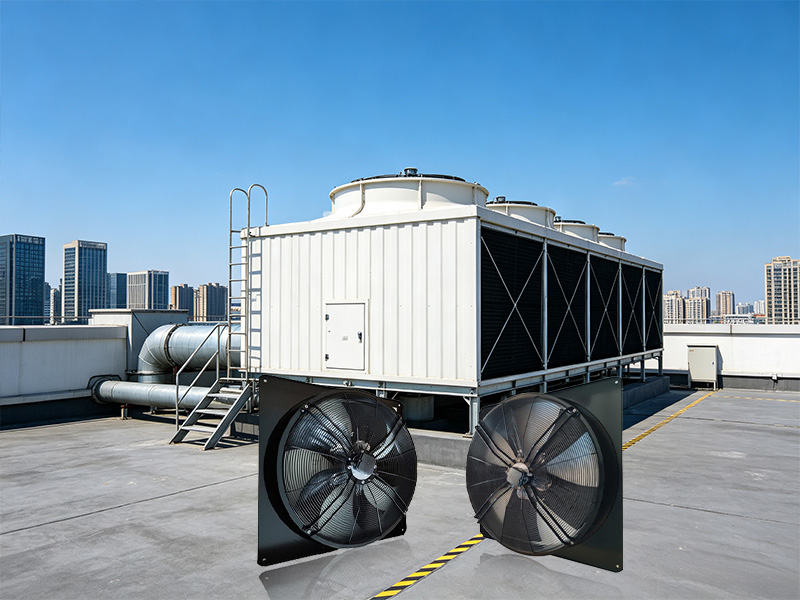
Inspect blades for cracks, erosion, deposits, corrosion, deformation, and loose hardware. Uneven deposits can create imbalance. Check tip clearance and look for rubbing marks or a distorted fan ring. Replacement blades or impellers must match the fan design and be balanced as specified. Improvised changes to blade angle can overload the motor or move the fan into an unsafe operating condition.
Motor and electrical issues
Low voltage, phase imbalance, a control fault, incorrect drive parameters, overheating, bearing damage, or winding problems can reduce speed or cause trips. Measure voltage and current under load and compare them with permitted values. For a variable-speed system, review the command, actual speed where available, minimum and maximum settings, and fault history. Repeated reset without finding the cause can damage equipment.
Vibration and abnormal noise
Imbalance, loose bolts, damaged bearings, shaft misalignment, resonance, blade contact, distorted inlet flow, and turbulent discharge can all create vibration or noise. Identify whether the frequency follows fan speed and whether it changes across the control range. Check the support structure as well as the fan. A new fan installed on a weak or cracked frame may reproduce the same symptom.
Poor fan and system matching
A fan can be mechanically healthy yet operate poorly because its curve does not match the tower resistance. A replacement chosen only by diameter or motor power may not reproduce the required airflow. Compare the operating point, pressure definition, speed, airflow direction, ring geometry, and accessory losses. If the existing tower has been modified, update the resistance estimate before selecting another fan.
When replacement is appropriate
Replacement should be considered when the fan cannot safely meet the required duty, key components are damaged or unavailable, efficiency is poor across the actual load profile, or the motor and controls no longer suit the plant. Provide suppliers with the duty point, dimensions, electrical data, environment, control requirements, photographs, and failure history. This information supports a defensible selection rather than a visual model match.
Conclusion
Cooling tower airflow problems often involve several interacting causes. Check rotation, speed, blades, ring clearance, motor condition, controls, fill, eliminators, inlets, discharge, and recirculation before deciding on replacement. Correct diagnosis prevents a new fan from inheriting an unresolved tower problem.